
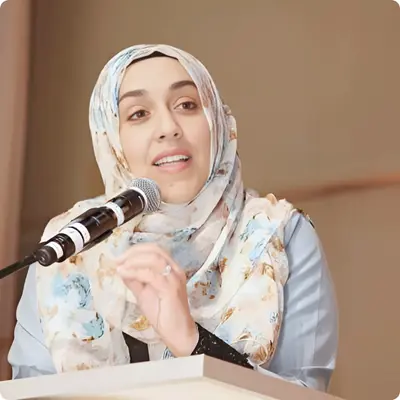
So, I went to a Yasmin Mogahed event for the first time… and the whole event was right up my street– It talked about psychology within an Islamic worldview, with the motivation of breaking cycles of dysfunction bred in our society so that we can uplift the Ummah. The event was jam packed with nuggets of wisdom, but here are a few of my reflections which I want to nerd out about (if you don’t mind).
What is Trauma?

Let’s start off with the concept of Trauma.
We often think only a select few people have Trauma. You may think that you’re not someone with trauma because you haven’t had an extreme experience which you’ve only heard people talk about and seen in films or the news. But the way Yasmin Mogahed spoke about trauma had a normalising element to it- which is the way my thinking has leaned towards it recently.
You see, there’s capital T Trauma, which is very severe Trauma brought about by extreme events or abuse, but there’s also lower-case t trauma- which on the outset looks like a less intense negative event (or events), but can still have lasting negative effects on the individual later on in life. This second category of trauma can be used in a more generalised way and has a larger perimeter.
You see, trauma is like a time-machine.
You may have had a negative experience (or repeated negative experiences) in your childhood which made you feel negative emotions. It then led to you holding certain negative beliefs about yourself, other people, or the world. You acted in your childhood in a way to protect yourself, whether that be psychologically or any another way. It became your learnt behaviours wired into you.
So now in your adulthood, when a situation presents itself with your current relationships that reminds you of that childhood experience, it triggers you.
And when you’re triggered, your body and mind are transported back to your childhood self who doesn’t feel safe, even though in reality it may not be the same situation. Your mind is now in survival mode, and you see what’s in front of you as the threat.
So, what happens next?...
Well, history repeats, and you go into survival mode and act in a way your younger self would have. This can take many forms- each specific to the person and experience. It may look like, shutting down communication, becoming defensive, becoming overly anxious and needy, or becoming overwhelmingly emotional.
Except…history doesn’t need to repeat- and that, in essence, was the message of Yasmin Mogahed’s talk.
Breaking the cycles

She didn’t go into this in depth because it will look somewhat different for each person, but the primary message was to emphasise the importance of confronting the trauma you hold in safety and processing those events in a healthy way. Please note, if you have severe trauma then it’s best to get help with a trauma specialist Insha’Allah, may Allah make things easier for you and grant you a full healing.
She reminded us of the truth that our negative childhood experiences were NOT our fault, but as adults it is our responsibility to heal, to live in peace, to create safety for ourselves and prevent that learnt pain from being spread to others in our lives (which consequently harbours a safe environment for others).
“Put out the fires”- as she called them, in our own houses, and in society- it starts with the self; confronting and dismantling our own limitations and dysfunctional communication.
Fundamentals

Again, reaffirmed in this talk was the sheer importance of orienting yourself correctly as a Muslim. That really is the central antidote to all of this chaos. To heal past pain and prevent future dysfunctional relationships.
The orientation being this: the primary and most important relationship in your life is always between you and Allah. No matter who you become, what roles you take on: wife, mother, doctor etc., Allah always is the most important. He is always the constant.
This is liberating.
It organically resolves dysfunction and unhealthy attachments; you worship God and God alone- not people. We start to live more authentically in a way which pleases God. This detaches you from all other relationships in life- you then give everyone their rights and are just. You still love the people in your life and fulfil your responsibilities- but you’re not a slave to anyone.
Nobody and nothing has control over your emotional states and internal environment. This prevents you from falling into toxicity and unhealthy relations because what pleases Allah comes before what pleases people- and that gives you space and peace. I believe this to be the purest way you can maintain boundaries.
You are no longer trapped by the whims and desires of others.
You’re not doing tawaf around anyone except Allah.
This quote on detachment is beautifully described in this quote by Imam Ali رضي الله عنه “Aim to live in this world without allowing the world to live inside you, because when a boat sits on water it sails perfectly, but when water enters inside the boat, it sinks.”
Generational trauma

I never really understood what Generational trauma was, but it clicked during this event: you see, the dysfunctional way we communicate in our adulthood- if we don’t overcome the trauma, is how we’ll show up to our children. Children learn from what they see, and then when they are older, they will go on to model that behaviour to their children, and so on and so forth. So, the key take-away here is that, we’ve got a big responsibility- not just to ourselves, but to our kids and wider society.
Dr Marriage
You can’t escape the marriage questions these days…it’s hot topic for the Muslim community. She talked about how marriage is one of the number 1 relationships which will trigger you because of how close you become to one another. One analogy she gave summed up a healthy way of approaching trauma which may surface in marriage:
Marriage is like an X-ray which exposes all of your ‘flaws’ and ‘diseases’ by the doctor (your spouse).
Now you have 2 choices.
Do you punch the doctor in the face, and say “How dare you show me all of my flaws and diseases!?” or….do you work with the doctor and embark on healing yourself so that you become healthy and stronger?
Marriage is a place for Mercy and Compassion after all-
As Allah says in the Quran…
“They are a garment for you, and you are a garment for them" (Surah Al-Baqarah, 2:187)
When those two components are properly honoured, what better worldly relationship is there to confront your past in safety?
Those are some of my key takeaways from the talk. I benefited a lot from it Alhamdullilah and I hope you find some benefit in this article too Insha’Allah. I would love to hear what you think below! I may do further articles on some points from the talk if interested…
P.S:
Did you know I work with Muslim women like you to help them excel- not only in their worldly goals, but also in their spiritual growth- by overcoming the mental blocks and limitations holding them back? My 5-week 1:1 coaching program is designed to help introverted Muslimah’s communicate with clarity and confidence, so they can show up fully in every part of life.
Let’s connect for a free discovery call to see if it’s the right fit for you. Step into the Muslim woman Allah created you to be — book your call today.
Grab your free Digital Download
& update emails on blog articles to level up as a Muslimah!

*Offer subject to end without notice
